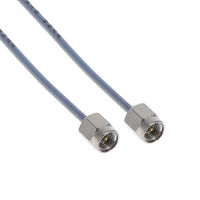
Coaxwave High-Temp RF Cable Assembly | 50Ω +200℃/+260℃ | PTFE+FEP Dual Shield | SMA/3.5mm/2.92mm/2.4mm/N/SMP/SSMP | Automotive Furnace Aero Downhole Radar
Architecture — Two Lines, One Thermal Commitment
Product Line | Cable Types | Temp Rating | Phase Stability | Flexibility | Frequency |
|---|---|---|---|---|---|
Flexible High-Temp | RG316 / RG393 / SFF | +200℃ | Moderate | Hand-flexible | DC–3GHz / 12GHz / 26.5GHz |
High-Temp Semi-Rigid | RG405 / RG402 | +260℃ | Excellent | Form-once | DC–26.5GHz / DC–40GHz |
All Transfer Models (complete high-temp cable assembly matrix — connector combination × cable line):
No. | Model Name | Conn A | Conn B | Cable Type | Temp | Freq | Notes |
|---|---|---|---|---|---|---|---|
1 | CW-HT-RG316-SMA-SMA | SMA | SMA | RG316 Flexible | +200℃ | DC-3GHz | General-purpose high-temp |
2 | CW-HT-RG393-SMA-SMA | SMA | SMA | RG393 Flexible | +200℃ | DC-12GHz | Higher-power high-temp |
3 | CW-HT-SFF-SMA-SMA | SMA | SMA | SFF Flexible | +200℃ | DC-26.5GHz | Extended-frequency flexible |
4 | CW-HT-RG316-SMA-SMP | SMA | SMP | RG316 Flexible | +200℃ | DC-3GHz | Blind-mate module at high temp |
5 | CW-HT-RG316-SMA-SSMP | SMA | SSMP | RG316 Flexible | +200℃ | DC-3GHz | Ultra-compact high-temp |
6 | CW-HT-SFF-SMA-SMP | SMA | SMP | SFF Flexible | +200℃ | DC-26.5GHz | mmWave blind-mate high-temp |
7 | CW-HT-SFF-SMA-SSMP | SMA | SSMP | SFF Flexible | +200℃ | DC-26.5GHz | Compact mmWave high-temp |
8 | CW-HT-RG393-N-N | N-Type | N-Type | RG393 Flexible | +200℃ | DC-12GHz | High-power base station hot zone |
9 | CW-HT-RG316-N-SMA | N-Type | SMA | RG316 Flexible | +200℃ | DC-3GHz | Cross-series high-temp |
10 | CW-HT-RG405-SMA-SMA | SMA | SMA | RG405 Semi-Rigid | +260℃ | DC-26.5GHz | Phase-stable extreme temp |
11 | CW-HT-RG402-292-292 | 2.92mm | 2.92mm | RG402 Semi-Rigid | +260℃ | DC-40GHz | mmWave extreme temp |
12 | CW-HT-RG402-24-24 | 2.4mm | 2.4mm | RG402 Semi-Rigid | +260℃ | DC-40GHz* | V-band extreme temp |
13 | CW-HT-RG405-35-35 | 3.5mm | 3.5mm | RG405 Semi-Rigid | +260℃ | DC-26.5GHz | Precision test extreme temp |
14 | CW-HT-RG402-292-SMP | 2.92mm | SMP | RG402 Semi-Rigid | +260℃ | DC-40GHz | Phased-array hot zone |
15 | CW-HT-RG402-24-SMP | 2.4mm | SMP | RG402 Semi-Rigid | +260℃ | DC-40GHz* | Radar T/R hot zone |
* RG402 with 2.4mm connectors supports DC–40GHz (limited by cable dielectric at elevated temp; 2.4mm interface rated to 50GHz).
💡 All 15 configurations share the same high-temp material architecture. Flexible line uses RG316 (0.98 mm OD), RG393 (2.50 mm OD), or SFF (2.20 mm OD). Semi-rigid line uses RG405 (2.20 mm OD) or RG402 (3.60 mm OD). Every assembly is built to order with 100% testing.
Key Performance (Coaxwave test specification):
Frequency Range: DC–40GHz (cable-dependent; RG316: 3GHz, RG393: 12GHz, SFF: 26.5GHz, RG405: 26.5GHz, RG402: 40GHz)
Impedance: 50Ω ±1Ω
Operating Temperature: +200℃ (flexible line); +260℃ (semi-rigid line)
Insertion Loss: Cable-dependent (RG316: ~0.35 dB/ft @ 1GHz; RG402: ~0.28 dB/ft @ 18GHz)
Shielding Effectiveness: > 90 dB (transfer impedance method)
Inspection: 100% VNA full-band S11/S21 sweep + high-temperature burn-in (dwell at rated temp, post-cool S-parameter re-verification) + mechanical integrity inspection. Each cable ships with an individual test report — actual S-parameters and thermal verification data. Laser-marked serial numbers guarantee full traceability.
🎯 Core Positioning: When the Environment Exceeds 150℃
Standard RF cables with PVC or polyethylene jackets begin to soften and outgas above 105℃. Coaxwave High-Temperature RF Cable Assemblies start where conventional cables stop. The PTFE dielectric remains dimensionally stable to +260℃, and the FEP jacket resists thermal degradation while maintaining flexibility. For applications inside engine bays, near industrial furnaces, or downhole, this is not a "feature upgrade" — it is a system requirement.
⚡ Complete Assembly Matrix
Flexible High-Temp Line (RG316 / RG393 / SFF):
RG316 (CW-HT-RG316-)*: 0.98 mm OD, silver-plated copper braid shield. DC–3GHz. The smallest high-temp option for dense routing in engine compartments and downhole tools.
RG393 (CW-HT-RG393-)*: 2.50 mm OD, double-shielded. DC–12GHz. Higher power handling for hot-zone transmit chains.
SFF Series (CW-HT-SFF-)*: 2.20 mm OD, expanded PTFE dielectric. DC–26.5GHz. Extended-frequency flexible for automotive radar sensors and aero telemetry.
High-Temp Semi-Rigid Phase-Stable Line (RG405 / RG402):
RG405 (CW-HT-RG405-)*: 2.20 mm OD, solid copper outer conductor. DC–26.5GHz. +260℃ rating. For industrial furnace sensor links and aero-engine test.
RG402 (CW-HT-RG402-)*: 3.60 mm OD, solid copper outer conductor. DC–40GHz. +260℃ rating. Lowest loss and best phase stability for radar feed networks in extreme heat.
Connector Coverage:
SMA / 3.5mm / 2.92mm / 2.4mm: Precision interfaces for test equipment and modular RF systems.
N-Type: High-power high-temp applications.
SMP / SSMP: Board-to-board push-on interfaces for space-constrained hot-zone modules.
🛡️ Coaxwave Quality Barrier
Every High-Temperature RF Cable Assembly undergoes three mandatory 100% tests:
100% VNA Full-Band S-Parameter Sweep: S11 and S21 measured across the operating band. Insertion loss and VSWR verified per assembly at room temperature.
High-Temperature Burn-In: Assembly placed in thermal chamber at rated temperature (+200℃ or +260℃) for minimum 4-hour dwell. Post-cool S-parameter re-verification confirms no performance shift.
Mechanical Integrity Inspection: Connector crimp/pull strength verified. Cable jacket inspected for thermal discoloration or deformation.
Each assembly ships with an individual test report — your cable's actual S-parameters and thermal verification data. Laser-marked serial numbers on every connector guarantee full traceability.
Electrical Performance
Frequency Range: DC – 40 GHz (cable-dependent; see matrix above)
Impedance: 50Ω ±1Ω
VSWR: ≤ 1.30:1 (typical, same-series connectors)
Insertion Loss: RG316: ~0.35 dB/ft @ 1GHz; RG393: ~0.20 dB/ft @ 1GHz; RG405: ~0.22 dB/ft @ 1GHz; RG402: ~0.15 dB/ft @ 1GHz
Shielding Effectiveness: > 90 dB (transfer impedance)
Mechanical Performance
Cable Types: RG316 (0.98mm OD), RG393 (2.50mm OD), SFF (2.20mm OD), RG405 (2.20mm OD), RG402 (3.60mm OD)
Minimum Bend Radius: Flexible: 5× OD (static), 10× OD (dynamic); Semi-rigid: 3× OD (form-once only)
Connector Coupling: Per interface standard (SMA/3.5mm/2.92mm: 1/4-36 UNS; 2.4mm: M7×0.75; N-Type: 1/4-28 UNS; SMP/SSMP: push-on)
Torque: Per connector specification (SMA: 0.9 N·m; 2.4mm: 0.45 N·m; N-Type: 1.1 N·m)
Materials & Structure
Inner Conductor: Silver-plated copper (solid or stranded, cable-dependent)
Dielectric: Solid PTFE (RG316/RG393/RG405/RG402) or expanded PTFE (SFF)
Shield 1: Silver-plated copper tape wrap (semi-rigid) or braid (flexible)
Shield 2: Silver-plated copper braid (dual-shield on all types)
Outer Jacket: FEP (fluorinated ethylene propylene), rated to +200℃ (flexible) / +260℃ (semi-rigid)
Connector Body: Passivated stainless steel or brass, gold-plated (per connector type)
Environment & Compliance
Operating Temperature: +200℃ (flexible line: RG316/RG393/SFF); +260℃ (semi-rigid line: RG405/RG402)
Storage Temperature: -65℃ ~ +260℃
Flame Rating: UL VW-1 (FEP jacket)
RoHS / REACH: Compliant (gold plating exemption per Directive 2011/65/EU Annex III)
Quality System: ISO 9001:2015 / AS9100D
Adaptation & Installation
Connector Torque:
SMA/3.5mm/2.92mm: 0.9 N·m (1/4-36 UNS) — use SMA torque wrench
2.4mm: 0.45 N·m (M7×0.75) — use dedicated 2.4mm wrench, NOT SMA wrench
N-Type: 1.1 N·m (1/4-28 UNS) — use N-Type wrench, NOT SMA wrench
Semi-Rigid Forming:
Form to final shape before installation — RG405/RG402 are form-once
Use a tubing bender; minimum bend radius 3× OD
Never re-bend — work-hardens copper outer conductor → crack → shield failure
High-Temp Routing:
Maintain minimum 10 mm clearance from heat sources exceeding rated temp
Use high-temp cable clamps (stainless steel or ceramic) — never use nylon ties
Avoid sharp edges that could cut the FEP jacket at elevated temp
Assembly Environment / System | Recommended Model | Core Advantage | Typical Application |
|---|---|---|---|
Automotive Engine Bay | CW-HT-RG316-SMA-SMA | RG316, +200℃, compact | Engine control module RF sensor |
Automotive Radar Sensor | CW-HT-SFF-SMA-SMP | SFF, +200℃, DC-26.5GHz | 77GHz radar front-end link (IF) |
Industrial Furnace Heating | CW-HT-RG405-SMA-SMA | RG405, +260℃, phase-stable | Furnace temperature sensor RF link |
Aero-Engine Telemetry | CW-HT-RG402-292-292 | RG402, +260℃, DC-40GHz | Engine-mounted sensor to telemetry |
Downhole Exploration | CW-HT-RG316-SMA-SSMP | RG316, +200℃, ultra-compact | Downhole tool string MMIC link |
Radar Feed Network | CW-HT-RG402-24-SMP | RG402, +260℃, 2.4mm to SMP | Hot-zone phased-array T/R feed |
SatCom HPA Hot Zone | CW-HT-RG393-N-N | RG393, +200℃, N-Type | High-power amplifier output |
Defense EW Hot Section | CW-HT-RG402-292-SMP | RG402, +260℃, mmWave | Electronic warfare module link |
University High-Temp Lab | CW-HT-RG316-SMA-SMA | RG316, +200℃, economical | Educational thermal testing |
Field Service Kit | CW-HT-SFF-SMA-SMA | SFF, +200℃, flexible | Portable high-temp test set |
Standard Matrix & Extensions
Two Product Lines: Flexible High-Temp (RG316/RG393/SFF) + High-Temp Semi-Rigid (RG405/RG402)
Connector Options: SMA, 3.5mm, 2.92mm, 2.4mm, N-Type, SMP, SSMP
Lengths: Any length from 50 mm to 15 m (flexible); 50 mm to 3 m (semi-rigid)
Full Kit: Cable assembly + protective caps + torque wrench (connector-specific) + individual test report
⚡ Electrical Performance Customization
Phase-Matched Sets: Multi-cable sets matched to ±3° at specified frequency for phased-array hot zones
Extended Frequency: SFF series supports up to DC-26.5GHz for automotive radar IF chains
Structural Customization
Right-Angle Connectors: 90° SMA/2.92mm for space-constrained engine bay routing
Bulkhead Feedthrough: Panel-mount for furnace wall or engine bulkhead penetration
Overmolded Strain Relief: High-temp silicone boot at connector-cable junction for vibration resistance
️ Material & Environmental Customization
ETFE Jacket Option: For applications requiring +150℃ with superior chemical resistance
Non-Magnetic Version: For EMC chambers and quantum high-temp test (zero nickel, zero iron)
Hermetically Sealed Connectors: For pressurized downhole tools
Service & Support
100% VNA Full-Band Characterization: Every cable measured across its operating band
Thermal Verification Data: High-temp burn-in results included in test report
SN Traceability: Laser-marked unique serial numbers on every connector
Rapid Prototyping: Standard configurations 2-3 week shipment; custom 4-6 weeks
Application Engineering: Coaxwave RF engineers provide:
Cable type selection (flexible vs. semi-rigid for your thermal profile)
Bend radius and high-temp routing recommendations
Phase matching strategy for multi-channel hot-zone systems
Connector torque and mating best practices per interface
Tip
"There is no perfect standard part, only the most suitable solution."
Automotive Engine Bay — RG316 SMA-to-SMA
Setup: RF sensor mounted on engine block operates at +180℃ ambient. ECU test port uses SMA female. Use CW-HT-RG316-SMA-SMA (500mm length).
Workflow: Form cable with gentle curves. Connect SMA male to sensor, torque to 0.9 N·m. Route along engine harness using stainless steel clamps. Connect other end to test VNA. Run sweep DC–3GHz.
Why This Cable: RG316 + FEP jacket rated to +200℃. Survives engine bay thermal cycling. Compact 0.98mm OD fits through existing harness conduits.
Industrial Furnace — RG405 Semi-Rigid Phase-Stable
Setup: Microwave heating cavity operates at +250℃ near the RF feed. Test equipment uses SMA ports. Use CW-HT-RG405-SMA-SMA (300mm, pre-formed).
Workflow: Form RG405 to a 90° bend with 6mm radius (3× OD). Mount one end to bulkhead SMA feedthrough, torque to 0.9 N·m. Other end to VNA. Place assembly in thermal chamber at +250℃ for 4 hours. Post-cool: S-parameters unchanged.
Why This Cable: RG405 solid copper outer conductor provides phase stability through thermal cycles. +260℃ rating exceeds furnace ambient. FEP jacket resists thermal degradation.
✈️ Aero-Engine Telemetry — RG402 2.92mm to SMP
Setup: Engine-mounted telemetry module at +230℃. Ground test set has 2.92mm ports. Module presents SMP female. Use CW-HT-RG402-292-SMP (200mm semi-rigid).
Workflow: Form RG402 to engine contour. Connect 2.92mm male to test set, torque to 0.9 N·m. Align SMP socket over module bullet, push straight in. Run VNA sweep DC–40GHz. Phase stable through engine thermal cycles.
Why This Cable: RG402 supports +260℃ and DC–40GHz. Phase-stable through extreme aero-engine thermal transients. SMP enables tool-free module connection in confined engine bay.
⚠️ Usage Red Lines
⚠️ Semi-Rigid Cables Are Form-Once — Never Re-Bend:
RG405/RG402 must be formed to final shape before installation
Re-bending work-hardens the copper outer conductor → crack → shield failure → total RF failure
Use a tubing bender with correct die radius (3× cable OD)
⚠️ FEP Jacket Has a Hard Limit — Respect +200℃ / +260℃ Ratings:
Flexible line (RG316/RG393/SFF): do NOT exceed +200℃ continuous
Semi-rigid line (RG405/RG402): do NOT exceed +260℃ continuous
Exceeding rating melts the FEP jacket → dielectric exposure → immediate failure
⚠️ Connector Torque Must Match Interface Type:
SMA/3.5mm/2.92mm: 0.9 N·m — use SMA wrench
2.4mm: 0.45 N·m — M7×0.75, NEVER use SMA wrench
N-Type: 1.1 N·m — 1/4-28 UNS, NEVER use SMA wrench
⚠️ SMP/SSMP Ends Are Push-On ONLY:
Align axially before pushing. Never force at an angle.
No torque required on SMP/SSMP side.
Coaxwave High-Temperature RF Cable Assembly · Delivery Commitment
Temperature Rating: +200℃ (flexible: RG316/RG393/SFF); +260℃ (semi-rigid: RG405/RG402)
Frequency: DC – 40 GHz (cable-dependent)
Impedance: 50Ω ±1Ω
Cable Lines: Flexible High-Temp (3 types) + High-Temp Semi-Rigid Phase-Stable (2 types)
Connector Matrix: SMA, 3.5mm, 2.92mm, 2.4mm, N-Type, SMP, SSMP
Materials: PTFE dielectric + FEP jacket + silver-plated copper + dual shield
100% VNA Full-Band S-Parameter Test + High-Temp Burn-In + Mechanical Integrity Inspection + Individual Test Report + SN Traceability
Quality System: ISO 9001 / AS9100D | sales@coaxial-rf.com
⚠️ Three Reminders for High-Temp Cable Selection:
Flexible vs. Semi-Rigid Is a Thermal AND Phase Decision: Flexible line (+200℃) for routing in tight spaces. Semi-rigid line (+260℃) when phase stability through thermal cycling is critical. Choose based on your dominant failure mode.
High-Temp Burn-In Data Is Per-Assembly, Not Per-Design: Every cable ships with actual thermal verification. Your cable's performance after +200℃/+260℃ exposure is documented — not estimated from a material datasheet.
Semi-Rigid Forming Is Permanent: RG405/RG402 must be formed once, correctly, before installation. Plan your routing carefully. For applications requiring repeated flexure at high temp, use the flexible line (RG316/RG393/SFF) instead.
There is no perfect standard part, only the most suitable solution.
Coaxwave High-Temperature RF Cable Assemblies are not merely off-the-shelf cables rated for "high temp" — they are the engineered result of selecting PTFE dielectric, FEP jacketing, and silver-plated copper dual shielding to survive environments where conventional cables fail. Every bend radius is respected, every S-parameter is verified with "German precision" and "French engineering logic", and every assembly ships with full SN traceability and thermal test data. With fifteen standard configurations covering every cable type and connector need, 100% VNA certification, and a commitment to extreme-environment performance, Coaxwave delivers the most suitable high-temperature cable for your exact automotive, industrial, aerospace, and downhole requirement.
Sales Email: sales@coaxial-rf.com
Company Website:


