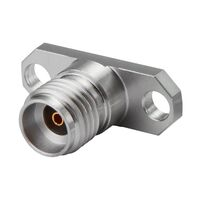
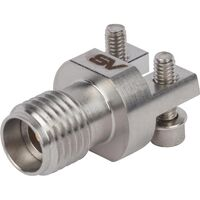
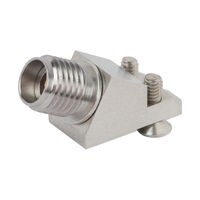
Coaxwave Cryonium™ Cryogenic DC-110GHz | 10mK-300K | Glass-Sealed Hermetic ≤10⁻⁹ atm·cc/s | SMA SMP SSMP 2.92mm 1.85mm 1.0mm | Quantum Superconducting
Coaxwave Cryonium™ is the definitive cryogenic RF interconnect platform for quantum computing and low-temperature physics. Standard RF connectors fail catastrophically below 4 K — thermal contraction loosens contacts, ferromagnetic plating disrupts qubit coherence, and polymer dielectrics outgas or fracture. Cryonium™ solves every failure mode: non-magnetic alloy bodies (beryllium copper, phosphor bronze, titanium) eliminate magnetic interference. Low thermal conductivity structures minimize parasitic heat load into the dilution refrigerator. Glass-sealed hermetic construction achieves helium leak rates ≤ 1×10⁻⁹ atm·cc/s. The full interface matrix spans SMA, SMP, SSMP, 2.92mm, 1.85mm, and 1.0mm — from DC to 110 GHz. Every unit is 100% helium-mass-spectrometer leak tested, thermal-cycled from 10 mK to 300 K, and VNA-tested across its full frequency range before shipment.
Architecture — Non-Magnetic, Low-Heat, Hermetic, 10 mK to 300 K
Attribute | Cryonium™ Cryogenic Connector Specification |
|---|---|
Characteristic Impedance | 50Ω ±2Ω |
Frequency Range | DC–110GHz (depends on interface: SMA/2.92mm to 40GHz, 1.85mm to 67GHz, 1.0mm to 110GHz) |
Hermetic Seal | Glass-sealed, helium leak rate ≤ 1×10⁻⁹ atm·cc/s |
Operating Temperature | 10 mK – 300 K (validated per batch) |
Magnetic Properties | Non-magnetic bodies — BeCu / phosphor bronze / titanium, no Ni/Fe/Co |
Thermal Conductivity | Optimized low-k structure to minimize parasitic heat load |
Body Material | Beryllium copper, phosphor bronze, or titanium alloy (all non-magnetic) |
Center Contact | Beryllium copper, gold-plated (no nickel barrier) |
Dielectric / Seal | Glass-ceramic composite (hermetic) or cryo-grade PTFE/PEI |
Interface Coverage | SMA, SMP, SSMP, 2.92mm (K), 1.85mm (V), 1.0mm (W) |
Coupling | Threaded (SMA/2.92/1.85/1.0) or push-on blind-mate (SMP/SSMP) |
All Transfer Models (every combination across all interfaces and gender sets):
No. | Model Family | End A | End B | Max Freq | Notes |
|---|---|---|---|---|---|
1 | CW-CRY-SMA-SMA-MM | SMA Male | SMA Male | DC–26.5GHz | In-line barrel, hermetic |
2 | CW-CRY-SMA-SMA-MF | SMA Male | SMA Female | DC–26.5GHz | Standard jumper |
3 | CW-CRY-SMA-SMA-FF | SMA Female | SMA Female | DC–26.5GHz | Panel feedthrough |
4 | CW-CRY-SMP-SMP-FD-MM | SMP Male (Full Detent) | SMP Male | DC–40GHz | High-retention blind-mate |
5 | CW-CRY-SMP-SMP-LD-MF | SMP Male (Limited Detent) | SMP Female | DC–40GHz | Standard blind-mate |
6 | CW-CRY-SMP-SMP-SB-FF | SMP Female (Smooth Bore) | SMP Female | DC–40GHz | Float-mate panel |
7 | CW-CRY-SSMP-SSMP-FD-MM | SSMP Male (Full Detent) | SSMP Male | DC–40GHz | Ultra-dense blind-mate |
8 | CW-CRY-SSMP-SSMP-SB-MF | SSMP Male (Smooth Bore) | SSMP Female | DC–40GHz | High-density float |
9 | CW-CRY-292-292-MM | 2.92mm (K) Male | 2.92mm Male | DC–40GHz | Precision threaded |
10 | CW-CRY-292-292-MF | 2.92mm (K) Male | 2.92mm Female | DC–40GHz | Standard K-jumper |
11 | CW-CRY-292-292-FF | 2.92mm (K) Female | 2.92mm Female | DC–40GHz | K-panel feedthrough |
12 | CW-CRY-185-185-MM | 1.85mm (V) Male | 1.85mm Male | DC–67GHz | V-band in-line |
13 | CW-CRY-185-185-MF | 1.85mm (V) Male | 1.85mm Female | DC–67GHz | V-band jumper |
14 | CW-CRY-185-185-FF | 1.85mm (V) Female | 1.85mm Female | DC–67GHz | V-band panel |
15 | CW-CRY-10-10-MM | 1.0mm (W) Male | 1.0mm Male | DC–110GHz | W-band in-line |
16 | CW-CRY-10-10-MF | 1.0mm (W) Male | 1.0mm Female | DC–110GHz | W-band jumper |
17 | CW-CRY-10-10-FF | 1.0mm (W) Female | 1.0mm Female | DC–110GHz | W-band panel |
18 | CW-CRY-SMA-292-MM | SMA Male | 2.92mm (K) Male | DC–26.5GHz | SMA-to-K bridge |
19 | CW-CRY-SMA-292-MF | SMA Male | 2.92mm (K) Female | DC–26.5GHz | K-port cryo adapter |
20 | CW-CRY-SMA-185-MM | SMA Male | 1.85mm (V) Male | DC–26.5GHz | SMA-to-V bridge |
21 | CW-CRY-SMA-185-MF | SMA Male | 1.85mm (V) Female | DC–26.5GHz | V-band test port |
22 | CW-CRY-292-185-MM | 2.92mm (K) Male | 1.85mm (V) Male | DC–40GHz | K-to-V bridge |
23 | CW-CRY-292-185-MF | 2.92mm (K) Male | 1.85mm (V) Female | DC–40GHz | V-panel adapter |
24 | CW-CRY-292-10-MM | 2.92mm (K) Male | 1.0mm (W) Male | DC–40GHz | K-to-W bridge |
25 | CW-CRY-292-10-MF | 2.92mm (K) Male | 1.0mm (W) Female | DC–40GHz | W-band transition |
26 | CW-CRY-185-10-MM | 1.85mm (V) Male | 1.0mm (W) Male | DC–67GHz | V-to-W bridge |
27 | CW-CRY-185-10-MF | 1.85mm (V) Male | 1.0mm (W) Female | DC–67GHz | W-band interface |
28 | CW-CRY-SMP-SMA-MF | SMP Male (FD) | SMA Female | DC–26.5GHz | Blind-mate to SMA |
29 | CW-CRY-SMP-292-MF | SMP Male (LD) | 2.92mm (K) Female | DC–40GHz | SMP-to-K cryo |
30 | CW-CRY-SSMP-SMA-MF | SSMP Male (SB) | SMA Female | DC–26.5GHz | Ultra-dense to SMA |
31 | CW-CRY-SSMP-185-MF | SSMP Male (FD) | 1.85mm (V) Female | DC–67GHz | SSMP-to-V bridge |
32 | CW-CRY-SSMP-10-MF | SSMP Male (LD) | 1.0mm (W) Female | DC–67GHz | SSMP-to-W transition |
💡 Every A-to-B combination across SMA, SMP, SSMP, 2.92mm (K), 1.85mm (V), and 1.0mm (W) is supported. All genders (M/M, M/F, F/F), threaded and blind-mate styles, straight and panel-mount configurations available. Every connector is 100% hermetic leak-tested and cryogenic-validated before shipment.
Key Performance (Coaxwave Cryonium™ specification):
Frequency Range: DC–26.5GHz (SMA), DC–40GHz (SMP/SSMP/2.92mm), DC–67GHz (1.85mm), DC–110GHz (1.0mm)
Hermetic Seal: Glass-sealed, helium leak rate ≤ 1×10⁻⁹ atm·cc/s (per-unit He-mass-spectrometer verified)
Temperature: 10 mK – 300 K (validated per batch, full thermal cycle)
Non-Magnetic: BeCu / phosphor bronze / titanium bodies — zero Ni/Fe/Co
🎯 Core Positioning: The Only RF Interconnect Validated from 10 mK to 300 K
In a dilution refrigerator operating at 10 mK, every milliwatt of parasitic heat load matters. Every ferromagnetic impurity disrupts superconducting qubit coherence. Every polymer seal fractures after 100 thermal cycles. Coaxwave Cryonium™ addresses all three through materials engineered for the cryogenic extreme: non-magnetic beryllium copper, phosphor bronze, and titanium alloy bodies eliminate magnetic interference. Glass-ceramic hermetic seals survive unlimited 10 mK ↔ 300 K cycles without fracture. Low thermal conductivity structural design minimizes conductive heat leak along the RF path. The result is a connector series that installs once and performs for the life of the quantum system.
⚡ Complete Interface Matrix
Same-Series Gender Sets:
SMA (CW-CRY-SMA-)*: DC–26.5GHz. Threaded 1/4-36 UNS. M-M / M-F / F-F. The workhorse interface for most dilution refrigerator RF lines.
SMP (CW-CRY-SMP-)*: DC–40GHz. Push-on blind-mate, Full/Limited Detent and Smooth Bore. For high-density multi-channel qubit readout arrays.
SSMP (CW-CRY-SSMP-)*: DC–40GHz. Smaller footprint than SMP. For ultra-dense cryogenic PCB stacking.
2.92mm / K (CW-CRY-292-)*: DC–40GHz. Threaded. Precision interface for Ka-band and mmWave cryogenic receivers.
1.85mm / V (CW-CRY-185-)*: DC–67GHz. Threaded. For W-band transition and high-frequency quantum control.
1.0mm / W (CW-CRY-10-)*: DC–110GHz. Threaded. The highest-frequency cryogenic interconnect in the Coaxwave portfolio.
Cross-Series Adapters:
SMA ↔ 2.92mm (K): Bridge standard SMA cryo lines to 40GHz test equipment without removing the dilution refrigerator thermal anchoring.
SMA ↔ 1.85mm (V): Adapt SMA infrastructure to V-band for advanced quantum control.
2.92mm ↔ 1.85mm (V): K-to-V transition — most common for 40→67GHz cryogenic receiver chains.
2.92mm ↔ 1.0mm (W): K-to-W bridge for mmWave superconducting detector readout.
1.85mm ↔ 1.0mm (W): V-to-W for full W-band (75–110GHz) cryogenic radiometry.
SMP/SSMP ↔ SMA / 2.92mm / 1.85mm / 1.0mm: Blind-mate SMP or SSMP on one end, threaded precision interface on the other. Enables dense array connection to individual channel test ports.
🛡️ Coaxwave Quality Barrier
Every Cryonium™ Connector undergoes four mandatory 100% controls:
Helium Mass Spectrometer Leak Test: Per-unit verification of hermetic seal integrity. Leak rate ≤ 1×10⁻⁹ atm·cc/s documented on each certificate.
10 mK – 300 K Thermal Cycle Validation: Per-batch verification — connectors subjected to at least 3 full cycles between base temperature and room temperature. Dimensional stability and contact resistance verified post-cycle.
100% VNA Full-Band S-Parameter Test: Swept across the full frequency range of the specific interface (10 MHz to 26.5/40/67/110 GHz depending on model). S11, S21 recorded.
Material Verification: XRF analysis confirming zero iron, nickel, and cobalt in body and plating. Non-magnetic certification included.
Electrical Performance
Characteristic Impedance: 50Ω ±2Ω
Frequency Range: DC–26.5GHz (SMA), DC–40GHz (SMP/SSMP/2.92mm), DC–67GHz (1.85mm), DC–110GHz (1.0mm)
VSWR: ≤ 1.25:1 (SMA/2.92mm DC–26.5GHz); ≤ 1.35:1 (1.85mm DC–40GHz); ≤ 1.40:1 (1.0mm DC–67GHz)
Insertion Loss: ≤ 0.05 × √f(GHz) dB (typical, per mated pair)
Dielectric Withstanding Voltage: ≥ 250V RMS (at room temperature, sea level)
Insulation Resistance: ≥ 2000 MΩ (at 300 K)
Mechanical Performance
Coupling Mechanism: Threaded (SMA/2.92/1.85/1.0: 1/4-36 UNS) or push-on (SMP/SSMP: Full/Limited Detent, Smooth Bore)
Recommended Torque (Threaded): SMA ~0.9 N·m; 2.92mm ~0.8 N·m; 1.85mm ~0.6 N·m; 1.0mm ~0.45 N·m (all with non-magnetic cryo wrench)
Blind-Mate Float (SMP/SSMP): Axial +0.25mm / Radial 3°
Mating Cycles: ≥ 300 (cryogenic service, proper handling)
Retention Force (SMP FD): 8–10 N axial
Materials & Structure
Body / Shell: Beryllium copper (BeCu), phosphor bronze, or titanium alloy Ti-6Al-4V — all non-magnetic, no Ni/Fe/Co
Center Contact: Beryllium copper (non-magnetic grade), gold-plated — no nickel barrier layer
Dielectric / Hermetic Seal: Glass-ceramic composite (hermetic, CTE-matched to body) or cryo-grade PTFE/PEI
Coupling Nut: Matching body material, gold-plated
Environment & Compliance
Operating Temperature: 10 mK – 300 K (validated per batch)
Hermetic Seal: Glass-sealed, helium leak rate ≤ 1×10⁻⁹ atm·cc/s (per-unit He-mass-spectrometer tested)
Magnetic Properties: Non-magnetic bodies — susceptibility verified per unit
Thermal Conductivity: Optimized low-k structure to minimize parasitic heat load into cryostat
Outgassing: TML < 1.0%, CVCM < 0.1% (ASTM E595, optional for space-cross-over applications)
RoHS / REACH: Compliant (gold plating exemption per Annex III, 6(c))
Quality System: ISO 9001:2015 / AS9100D
Adaptation & Installation
Threaded Interfaces — Use Non-Magnetic Cryo Wrench: Standard steel wrenches are ferromagnetic and introduce heat. Use ONLY Coaxwave-supplied non-magnetic cryogenic torque wrench.
Thermal Anchoring Required: Every RF line entering a dilution refrigerator must be thermally anchored at each temperature stage (300K → 4K → 100mK → 10mK). The connector body itself is part of the thermal path — select body material based on acceptable heat conductivity budget.
Glass Seal Handling: Glass-ceramic hermetic seals are robust but brittle. Avoid side-loading during installation. Align carefully before finger-starting threads.
⚠️ Thermal Contraction Is Significant: Titanium contracts ~0.15% from 300K to 10 mK; BeCu ~0.2%; glass-ceramic ~0.05%. Cable assembly lengths must be compensated for the target base temperature.
Assembly Environment / System | Recommended Model | Core Advantage | Typical Application |
|---|---|---|---|
Dilution Refrigerator Qubit Control | CW-CRY-SMA-SMA-MF (BeCu) | 10mK, non-magnetic, hermetic | 16-channel flux pulse line |
Superconducting Resonator Readout | CW-CRY-SMP-SMP-FD-MF (Ti) | Blind-mate, 40GHz, low heat | 64-channel SMP array |
Cryogenic mmWave Receiver | CW-CRY-185-185-MF (BeCu) | 67GHz, hermetic | Radio astronomy LNA chain |
Deep-Space Cryo Sensor | CW-CRY-10-10-MF (Ti) | 110GHz, lowest heat leak | W-band cryogenic detector |
Quantum Annealing System | CW-CRY-SSMP-SSMP-SB-MF (BeCu) | Ultra-dense, float alignment | 256-channel coupler array |
SQUID Magnetometer | CW-CRY-SMA-292-MF (Ti) | 40GHz bridge, zero Ni/Fe | SQUID readout RF chain |
Particle Physics Detector | CW-CRY-292-10-MF (BeCu) | K-to-W, hermetic | Cryogenic calorimeter output |
Academic Quantum Lab | CW-CRY-SMA-185-MF (BeCu) | General-purpose, 67GHz | Superconducting circuit test |
Standard Matrix & Extensions
Interface Coverage: SMA, SMP (FD/LD/SB), SSMP (FD/SB), 2.92mm (K), 1.85mm (V), 1.0mm (W)
Gender Sets: M-M, M-F, F-F across all interfaces
Cross-Series Adapters: SMA↔2.92mm, SMA↔1.85mm, 2.92mm↔1.85mm, 2.92mm↔1.0mm, 1.85mm↔1.0mm, SMP/SSMP↔all
Full Kit: Connector + non-magnetic cryo torque wrench + protective caps + serialized test report
⚡ Electrical Performance Customization
Frequency Optimization: Return loss and insertion loss tuned for specific bands (e.g., 4–8 GHz qubit drive, 90–110 GHz W-band radiometry)
Phase-Matched Sets: Multiple connectors matched for multi-channel phased quantum arrays
Cryogenic Cable Assembly: Semi-rigid or flexible cryo-grade cables pre-assembled and VNA-tested at 4 K (optional)
Structural Customization
Custom Flange Patterns: Non-standard hole spacing for legacy dilution refrigerator or custom dewar flanges
Captive Center Contact: For field-replaceable applications in sealed cryostats
Right-Angle Variants: 90° for constrained cryostat routing (consult Coaxwave)
️ Material & Environmental Customization
Body Material Selection: BeCu (best RF conductivity), phosphor bronze (lowest cost non-magnetic), titanium (lowest heat conductivity, lowest μr)
Heavy Gold Plating: Thick gold for maximum mating-cycle life in test systems that warm up frequently
Alumina or Sapphire Dielectric: For extreme thermal conductivity at base temperature (consult Coaxwave)
Service & Support
100% Cryogenic Test Report: Every connector ships with helium leak rate data, thermal cycle validation, non-magnetic certification, and full S-parameters
Serialized Traceability: Laser-marked serial numbers on connector bodies
Rapid Prototyping: Standard 3–4 weeks; custom 6–8 weeks (hermetic seal + cryo validation cycle)
Application Engineering: Coaxwave RF engineers provide:
Body material selection (BeCu vs. phosphor bronze vs. titanium) based on heat load budget, magnetic field strength, and RF loss
Thermal anchoring strategy for multi-stage dilution refrigerators
Cable length compensation for 10 mK thermal contraction
Cross-series interface selection for qubit control, readout, and mmWave cryogenic receivers
Tip
"There is no perfect standard part, only the most suitable solution."
Dilution Refrigerator Qubit Control — SMA, BeCu, 10 mK
Setup: Superconducting transmon qubit chip at 10 mK. 16 control lines, DC–8 GHz bandwidth. Use CW-CRY-SMA-SMA-MF (BeCu body, glass-ceramic seal, straight).
Workflow: Connector flange-mounted on refrigerator wall (4 K stage thermal anchor). SMA male on internal semi-rigid cable hand-tight (0.9 N·m, non-magnetic cryo wrench). System cooled to 10 mK. Qubit coherence T2 within specification.
Why This Connector: BeCu body has best RF conductivity among non-magnetic options. Glass-ceramic hermetic seal prevents helium ingress. 10 mK validation ensures dimensional stability. Zero Ni/Fe/Co — no magnetic dipole to perturb qubits.
Cryogenic mmWave Receiver — 1.85mm, Radio Astronomy
Setup: Ground-based radio telescope, cryogenic HEMT LNA at 4 K. 70–85 GHz RF band. Use CW-CRY-185-185-MF (BeCu, glass-sealed, 67GHz+ capable).
Workflow: 1.85mm female receptacle on LNA module. Male plug on cryo-flex cable hand-tight (0.6 N·m). System thermal-cycled from 300 K to 4 K — contact stable, noise temperature meets specification.
Why This Connector: 67GHz+ bandwidth covers 70–85 GHz band. Glass-ceramic hermetic seal maintains vacuum integrity of cryostat. Low thermal conductivity structure minimizes heat leak to 4 K stage.
SQUID Array Readout — SMP Full Detent, Titanium
Setup: 64-channel SQUID magnetometer array for dark matter detection. 10 mK operation. Use CW-CRY-SMP-SMP-FD-MF (titanium body, Full Detent, PEI dielectric).
Workflow: SMP female on readout board. Male on cryo-cable pushed into place — 64 channels engage with tactile click. System cooled to 10 mK. All channels functional.
Why This Connector: Titanium body — lowest heat conductivity (minimizes parasitic load on dilution refrigerator) and lowest magnetic susceptibility. Full Detent retains connection through thermal cycling. Blind-mate enables dense 64-channel array.
⚠️ Usage Red Lines
⚠️ ABSOLUTELY NO FERROMAGNETIC TOOLS:
Standard steel torque wrenches are ferromagnetic — they WILL disrupt superconducting qubit states and SQUID measurements
Only non-magnetic stainless steel, brass, bronze, or titanium tools allowed. Coaxwave supplies a non-magnetic cryo torque wrench on request
⚠️ Thermal Anchoring Is Mandatory:
Every RF line entering a dilution refrigerator MUST be thermally anchored at each temperature stage. The connector body conducts heat
Failure to thermal-anchor causes cryostat overload, extended cool-down time, and potential qubit decoherence
⚠️ Glass Seal — No Side Load:
Glass-ceramic hermetic seals survive axial compression and thermal cycling but fracture under side-load
Align connectors perfectly before mating. Never force a misaligned connection
⚠️ Cable Length Must Account for 10 mK Contraction:
All materials contract from 300 K to 10 mK. Semi-rigid coax typically contracts ~0.2–0.3%
Pre-compensate cable lengths at room temperature. Over-constrained cables will fracture glass seals or deform PCB pads at base temperature
Coaxwave Cryonium™ Cryogenic Connector · Delivery Commitment
Impedance: 50Ω ±2Ω
Frequency Range: DC–26.5GHz (SMA), DC–40GHz (SMP/SSMP/2.92mm), DC–67GHz (1.85mm), DC–110GHz (1.0mm)
Hermetic Seal: Glass-sealed, helium leak rate ≤ 1×10⁻⁹ atm·cc/s (per-unit He-mass-spectrometer verified)
Temperature Range: 10 mK – 300 K (validated per batch)
Body Options: Beryllium copper / Phosphor bronze / Titanium alloy (all non-magnetic, no Ni/Fe/Co)
Adapter Matrix: SMA / SMP / SSMP / 2.92mm / 1.85mm / 1.0mm — any A-to-B, all genders, threaded + blind-mate
100% He-Leak Test + 10mK–300K Thermal Cycle + VNA S-Parameters + Non-Magnetic Certification + Serialized Traceability
Quality System: ISO 9001 / AS9100D | sales@coaxial-rf.com
⚠️ Three Reminders for Cryonium™ Selection:
Body Material = Heat Budget Decision: Titanium for lowest heat leak. Phosphor bronze for lowest cost. Beryllium copper for best RF. Choose before system thermal modeling.
Glass Seal Is the Differentiator: Polymer seals outgas and fracture below 4 K. Only glass-ceramic hermetic seals survive unlimited 10 mK cycles. Demand the helium leak certificate.
10 mK Is Not a Marketing Claim: Every Cryonium™ batch is thermal-cycled to 10 mK and verified. If your application involves dilution refrigerators, this is the only connector series with documented 10 mK validation.
There is no perfect standard part, only the most suitable solution.
Coaxwave Cryonium™ Cryogenic Connectors are engineered interconnects where non-magnetic alloy purity, glass-sealed hermetic integrity, and low-thermal-conductivity architecture deliver the most trusted RF interface from 10 mK to 300 K for quantum computing, superconducting physics, and cryogenic radio astronomy. Every connector is helium-leak-tested, thermal-cycled, and VNA-verified with "German precision" and "French engineering logic", and ships with full serialized traceability. With the industry's most complete cryogenic interface matrix spanning SMA, SMP, SSMP, 2.92mm, 1.85mm, and 1.0mm, Coaxwave delivers the most suitable cryogenic solution for your exact ultra-low-temperature requirement.
Sales Email: sales@coaxial-rf.com
Company Website:


